
US Fuel Exports Surge as Strait of Hormuz Closure Disrupts Supply
Coveragetap to expand ▾Spectrum: Mostly Center🌍Other: 3 · US: 2
- U.S. oil product exports have reached nearly 8.2 million barrels a day, a record high (per washingtonexaminer.com).
- The Strait of Hormuz has been effectively closed due to the war with Iran, constraining oil supply (per washingtonexaminer.com).
- Around 80% of the oil that passes through the strait is destined for Asian markets (per washingtonexaminer.com).
- Countries in Europe and Asia are seeking alternatives to oil shipped through the Strait of Hormuz (per washingtonexaminer.com).
The United States has seen a significant increase in its fuel exports, reaching record highs as the ongoing conflict with Iran disrupts traditional oil supply routes. The closure of the Strait of Hormuz, a critical chokepoint for global oil transport, has led to a surge in demand from countries in Europe and Asia seeking alternative sources of oil.
This has resulted in U.S. oil product exports, including gasoline, jet fuel, and diesel, climbing to nearly 8.2 million barrels a day, marking a 23% increase from the same period last year. The Strait of Hormuz, through which about 20% of the world's oil supply typically passes, has been effectively closed since late January due to the war with Iran.
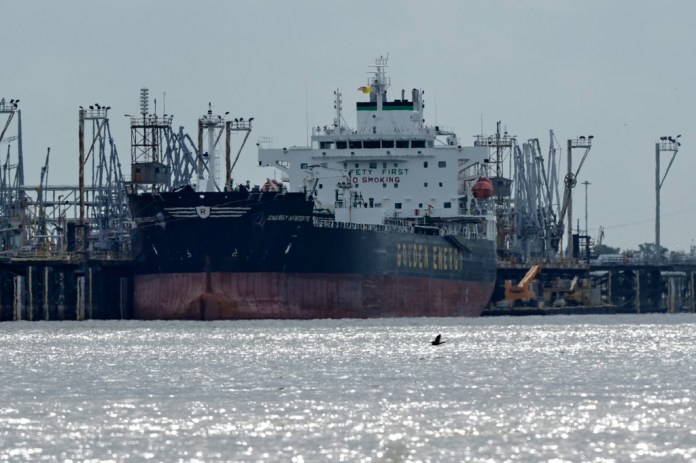
This closure has particularly affected Asian markets, which account for approximately 80% of the oil that transits through the strait. In response, Asian buyers have increasingly turned to the United States to fulfill their energy needs. The increased demand for U.S. oil products has also been reflected in the heightened activity at American ports.
For instance, the port of Corpus Christi saw ship traffic rise to over 240 vessels in March, compared to the usual 200 vessels for the same month. This uptick underscores the shifting dynamics in global oil trade as countries adapt to the disruptions caused by the conflict.
The war with Iran has not only strained global oil supplies but also highlighted the strategic importance of the Strait of Hormuz. As countries in Europe and Asia scramble to secure alternative energy sources, the United States has emerged as a key supplier, capitalizing on the opportunity to expand its market share in the global oil industry.
While the immediate effects of the strait's closure are evident in the increased U.S. exports, the long-term implications for global energy markets remain uncertain. The situation underscores the vulnerability of global oil supply chains to geopolitical tensions and the critical role of strategic chokepoints like the Strait of Hormuz.
As the conflict continues, many governments will be closely monitoring the developments in the region and their impact on global energy security. The United States, by stepping up its exports, is playing a pivotal role in mitigating some of the supply disruptions, but the broader geopolitical landscape remains fraught with uncertainty.
- European and Asian countries bear the concrete costs as they face constrained oil supplies due to the closure of the Strait of Hormuz, leading to increased energy prices and potential economic strain.
- The United States benefits from the increased demand for its oil products, expanding its market share and boosting its energy sector amid global supply disruptions.
- The closure of the Strait of Hormuz highlights the vulnerability of global oil supply chains to geopolitical tensions, emphasizing the need for diversified energy sources.
- Whether the United States maintains its record-high export levels in the coming months.
- Developments in the conflict with Iran that could affect the status of the Strait of Hormuz.
- Potential shifts in European and Asian energy policies as they seek long-term alternatives to Iranian oil.
Left- and right-leaning outlets are covering this story differently — in which facts to emphasize, which context to include, and how to frame causes and consequences.
7 specific areas where coverage diverges — see below.
- No significant framing differences noted as only one source was provided.
- No disputed or unclear facts noted as only one source was provided.
- No source mentions the specific economic impact on Asian countries heavily reliant on oil from the Strait of Hormuz.
- No differing figures noted as only one source was provided.
- No causality disagreements noted as only one source was provided.
- No differing attributions noted as only one source was provided.