
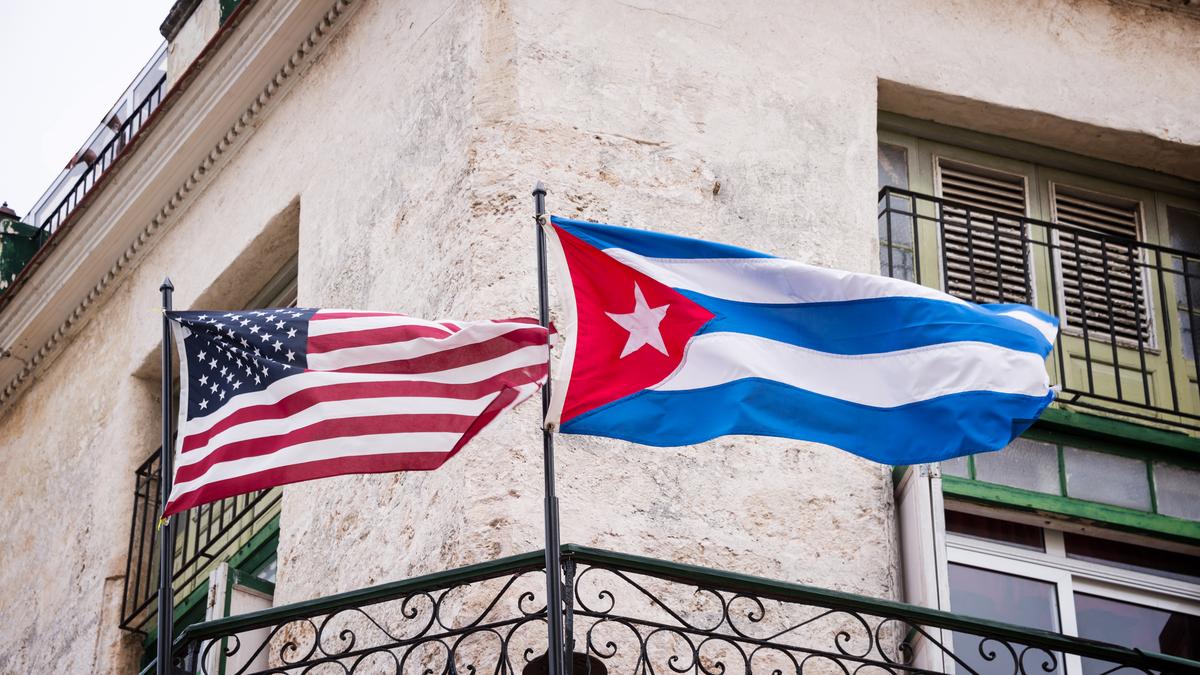
US Officials Deny Imminent Military Action in Cuba Despite Trump's Threats
Coveragetap to expand ▾Spectrum: Mostly Center🌍US: 2 · Asia: 1
- The United States is not considering imminent military action against Cuba, despite President Donald Trump's threats that 'Cuba is next' (per AP News, Washington Times).
- President Trump suggested that American warships deployed in the Middle East could return via Cuba (per Washington Times).
- U.S. officials have been involved in preliminary discussions with Cuban authorities but are not optimistic about Cuba accepting humanitarian aid (per Washington Times).
- The offer of humanitarian aid to Cuba includes conditions that the Cuban government has long resisted (per Washington Times).
- Cuba has not outright refused the U.S. offer of aid, but acceptance seems unlikely due to the attached conditions (per Washington Times).
According to U.S. officials, while Trump has publicly stated that 'Cuba is next' and hinted that American warships currently in the Middle East could return via Cuba, there are no current plans to initiate military operations against the island nation.
These statements come amidst ongoing tensions in the Middle East, where U.S. forces are engaged in operations related to the conflict with Iran. In parallel, U.S. officials have been engaging in preliminary discussions with Cuban authorities regarding the provision of humanitarian aid.
However, these officials have expressed skepticism about the likelihood of Cuba accepting the aid offer. The aid package, reportedly worth tens of millions of dollars, comes with conditions that the Cuban government has historically resisted. While Cuba has not outright rejected the offer, the conditions attached make acceptance improbable.
The situation reflects a complex interplay of diplomatic and military considerations. On one hand, President Trump's rhetoric suggests a hardline stance towards Cuba, potentially as a strategic maneuver linked to broader geopolitical objectives.
On the other hand, the lack of immediate military plans indicates a more cautious approach by U.S. officials, who may be weighing the potential repercussions of escalating tensions with Cuba.
The offer of humanitarian aid, despite its conditional nature, could be seen as an attempt by the U.S. to engage with Cuba on a different front, possibly to mitigate some of the tensions exacerbated by Trump's threats. However, the conditions attached to the aid are a significant barrier, reflecting longstanding issues in U.S.-Cuba relations.
This development occurs against the backdrop of heightened U.S. military activity in the Middle East, where American forces are involved in operations against Iran. The suggestion that warships could return via Cuba adds a layer of complexity to the U.S.'s strategic military positioning.
Overall, while President Trump's statements have raised concerns about potential military action, the current stance of U.S. officials suggests a more measured approach, focusing on diplomatic engagement and conditional aid rather than immediate military intervention.
- Cuban citizens could face increased economic hardship if U.S. aid is withheld due to the Cuban government's refusal of conditional offers.
- The Cuban government stands to lose potential humanitarian aid, which could alleviate some domestic challenges, if they reject the U.S. conditions.
- U.S. military resources are currently focused on the Middle East, indicating that a shift towards Cuba could strain existing operations.
- Whether the Cuban government accepts or rejects the U.S. offer of humanitarian aid.
- Any changes in U.S. military deployments that might indicate a shift towards Cuba.
- Further statements from President Trump regarding U.S. policy towards Cuba.
Left- and right-leaning outlets are covering this story differently — in which facts to emphasize, which context to include, and how to frame causes and consequences.
4 specific areas where coverage diverges — see below.
- Both sources agree on the lack of imminent military action but differ in emphasis; AP News focuses on the denial of military plans, while Washington Times highlights Trump's threats and the aid offer.
- No source disputes the lack of imminent military action; however, the likelihood of Cuba accepting aid remains uncertain.
- No source mentions the historical context of U.S.-Cuba relations, including past embargoes and diplomatic tensions, which are relevant to understanding the aid conditions.
- President Trump's claim that 'Cuba is next' and the suggestion that warships could return via Cuba are notable claims reported by Washington Times.