
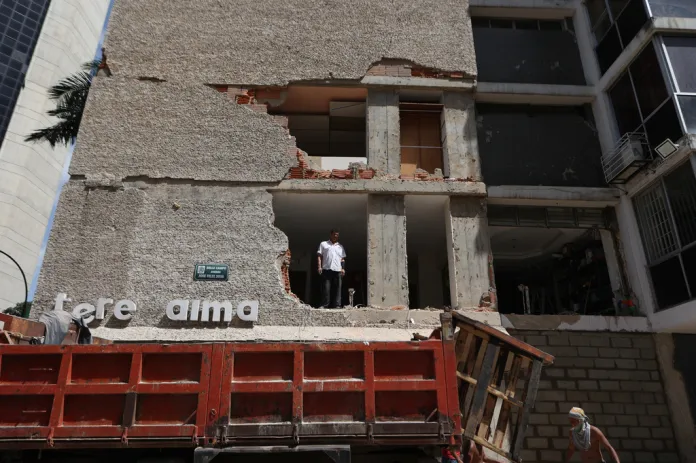
US Teams Mobilize for Earthquake Relief Efforts in Venezuela
Topic: climate & environmentRegion: Latin AmericaUpdated: i2 outletsSources: 5⚠ Bias gap — sources divergeSpectrum: Mostly Center⏱ 4 min read📡 Wire pickup
Story Summary
SITUATION
US search and rescue teams are deploying to assist Venezuela following devastating earthquakes that killed nearly 1,500 people. The State Department activated additional urban search and rescue teams to aid in recovery operations (per Washington Examiner).
Coveragetap to expand ▾Spectrum: Mostly Center🌍US: 2 · Other: 2 · Europe: 1
Political Spectrum
Position is inferred from coverage mix.
i2 outlets · Center
Left
Center
Right
Left: 0
Center: 4
Right: 1
Geography Coverage
Distribution of where coverage is coming from.
i2 unique outlets · Dominant: US/Canada
KEY FACTS
- The pair of powerful earthquakes that shook Caracas on Wednesday evening had magnitudes of 7.2 and 7.5, making them among the strongest to rock the country in over a century.
- International rescue teams, including groups from the U.S., have been deployed to help the embattled country as it grapples with the devastation caused by the earthquakes in the capital and nearby cities.
HISTORICAL CONTEXT
In June 2026, Venezuela experienced a series of devastating earthquakes, with magnitudes of 7.2 and 7.5 striking the capital, Caracas, and surrounding areas. These earthquakes are among the most powerful to hit the country in over a century, leading to significant destruction and loss of life.
The international community, including the United States, mobilized search and rescue teams to assist in the aftermath, reflecting a growing trend of international humanitarian response to natural disasters in the region.
Brief
In the wake of powerful earthquakes that struck Caracas, US search and rescue teams are mobilizing to assist Venezuela, where nearly 1,500 people have been confirmed dead. The earthquakes, registering magnitudes of 7.2 and 7.5, are among the strongest to hit the country in over a century, prompting an urgent international response.
Venezuelan officials reported a staggering increase in casualties, with 1,430 confirmed dead and 68,900 missing as of Saturday morning, a significant rise from earlier estimates. The US State Department has activated additional urban search and rescue teams to support recovery efforts, emphasizing the importance of international cooperation in times of crisis.
Venezuelan officials have publicly expressed their gratitude for the assistance, framing it as a gesture of friendship amid ongoing challenges. As search and rescue operations continue, the focus remains on locating survivors and providing necessary aid to affected communities.
The situation underscores the critical need for international support in the face of natural disasters, particularly in countries grappling with existing humanitarian crises.
Where sources differ
Bias gap0.50 / 2.0
Left- and right-leaning outlets are covering this story differently — in which facts to emphasize, which context to include, and how to frame causes and consequences.
Center (4)
wsvn.comtheguardian.comreuters.comopenthemagazine.com
Right-leaning (1)
washington_examiner+0.70
US search and rescue teams deploy to help Venezuela earthquake response US search and rescue teams deploy to help Venezuela earthquake response US search and rescue teams deploy to…
Sources
5 of 5 linked articles
US search and rescue teams deploy to help Venezuela earthquake response
washingtonexaminer.comJun 27Center
↗
South Florida search and rescue teams set to deploy to aid Venezuela after devastating earthquakes
wsvn.comJun 26Left
↗
Rescue teams race to Venezuela amid fears thousands killed in earthquakes
theguardian.comJun 25Left
↗
Rubio says US search and rescue teams deploying to Venezuela
reuters.comJun 25Left
↗
Venezuela Earthquakes: US Sends Rescue Teams, Aerial Surveillance to Aid Relief Efforts
openthemagazine.comJun 25Left
↗