
Venice Biennale faces outcry over Israel and Russia's participation
Coveragetap to expand ▾Spectrum: Center Only🌍Europe: 4 · Other: 3 · ME: 1
- The Venice Biennale is the world's largest contemporary art exhibition, held every two years in Venice, Italy (per france24.com).
- This year's Biennale has faced backlash due to the participation of Israel and Russia, leading to boycotts and threats (per france24.com).
- The Biennale features artists from several nations in conflict, including Ukraine, Israel, and the United States, while Iran has canceled its participation (per france24.com).
- The controversy has made this edition of the Biennale one of the most chaotic in its history (per france24.com).
The Venice Biennale, the world's largest contemporary art exhibition, is embroiled in controversy due to the participation of Israel and Russia. This has led to significant backlash, including boycotts and the unprecedented resignation of the event's jury.
The Biennale, which takes place every two years in Venice, Italy, features artists from various nations, some of which are currently in conflict, such as Ukraine, Israel, and the United States. However, Iran has opted out of this year's event.
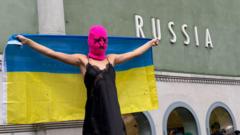
The inclusion of Russia has been particularly contentious, as it marks the country's return to the Biennale following its full-scale invasion of Ukraine. In response, the Russian punk protest group Pussy Riot and Femen, a group founded in Ukraine, staged a joint protest.
The activists, dressed in black with fluorescent pink balaclavas, demonstrated outside the Russian national pavilion, drawing attention to their opposition to Russia's participation. The controversy surrounding the Biennale has made this edition one of the most chaotic in its history.
The event's structure has been undermined by the jury's resignation, which was a direct response to the inclusion of Israel and Russia. This has raised questions about the Biennale's ability to navigate the complex political landscape and maintain its position as a leading platform for contemporary art.
The protests and boycotts highlight the broader geopolitical tensions that have seeped into the art world. The Biennale's decision to include artists from nations in conflict has sparked debate about the role of art in political discourse and the responsibilities of cultural institutions in such contexts.
While the Biennale aims to provide a platform for artistic expression, the participation of countries involved in ongoing conflicts has overshadowed the event's artistic focus. The backlash underscores the challenges faced by international cultural events in maintaining neutrality and inclusivity amid global political tensions. As the Biennale continues,
- The controversy at the Venice Biennale affects participating artists and nations, as boycotts and protests disrupt the event and undermine its structure.
- The backlash highlights the geopolitical tensions that influence cultural events, affecting the Biennale's reputation and its ability to remain a neutral platform.
- Activists like Pussy Riot and Femen benefit from increased visibility for their causes, using the Biennale as a stage for political protest.
- Whether the Venice Biennale organizers address the criticisms and manage to stabilize the event's structure.
- Potential further protests or boycotts by other participating nations or artists.
- The impact of Iran's cancellation on the Biennale's overall participation and reception.
- BBC emphasizes the protest by Pussy Riot and Femen against Russia's participation, while france24.com focuses on the broader backlash and jury resignation over both Israel and Russia's involvement.
- No source mentions the specific reasons behind Iran's cancellation of participation.
- The sources do not provide detailed information on the specific artworks or artists involved from Israel and Russia.