
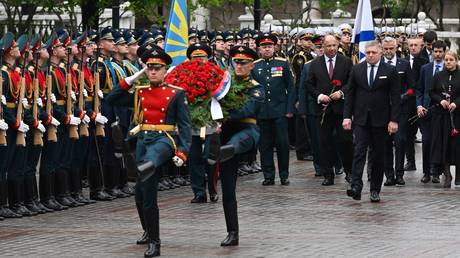
Russia Cuts Victory Day Events Citing Drone Threats and Security Risks
Coveragetap to expand ▾Spectrum: Mixed🌍US: 2 · Europe: 1 · ME: 1 · Other: 1
- Russia has scaled back its Victory Day celebrations amid security concerns (per news.google.com).
- The decision was influenced by threats from drones, which pose a significant security risk (per news.google.com).
- Victory Day is a significant event in Russia, commemorating the Soviet Union's victory in World War II (per news.google.com).
Russia has decided to scale back its traditional Victory Day celebrations, citing security concerns and the threat posed by drones. This move comes as the country faces increased security risks, which have prompted authorities to take precautionary measures to ensure public safety.
Victory Day, which marks the Soviet Union's victory in World War II, is a significant event in Russia, typically involving large public gatherings and military parades. However, this year, the celebrations will be more subdued as officials prioritize the safety of participants and attendees.
The decision to reduce the scale of the events highlights the ongoing security challenges facing Russia, particularly in light of recent drone threats. These threats have raised concerns about potential disruptions and the safety of large public gatherings.
By scaling back the celebrations, Russian authorities aim to mitigate these risks and prevent any incidents that could endanger the public. The move reflects a broader trend of heightened security measures in response to evolving threats, as governments worldwide grapple with the challenges posed by new technologies and unconventional security risks.
As Russia navigates these challenges, the decision to prioritize safety over tradition underscores the importance of adapting to changing security landscapes.
- Russian citizens bear the concrete costs as public celebrations are curtailed, impacting cultural traditions and community gatherings.
- The Russian government benefits by potentially averting security incidents, maintaining public safety, and demonstrating proactive risk management.
- Drone threats highlight vulnerabilities in public event security, prompting governments to reassess safety protocols and adapt to new technological challenges.
Whether Russian authorities implement additional security measures for future public events. 2) Potential changes in drone regulation and counter-drone technology deployment in Russia. 3) Public reaction to the scaled-back Victory Day celebrations and any subsequent government responses.
Left- and right-leaning outlets are covering this story differently — in which facts to emphasize, which context to include, and how to frame causes and consequences.
7 specific areas where coverage diverges — see below.
- No significant framing differences noted as only one source was provided.
- No disputes or unclear facts noted as only one source was provided.
- No source mentions the broader geopolitical tensions that may influence security concerns in Russia.
- No differing figures noted as only one source was provided.
- No causality disagreements noted as only one source was provided.
- No differing attributions noted as only one source was provided.