
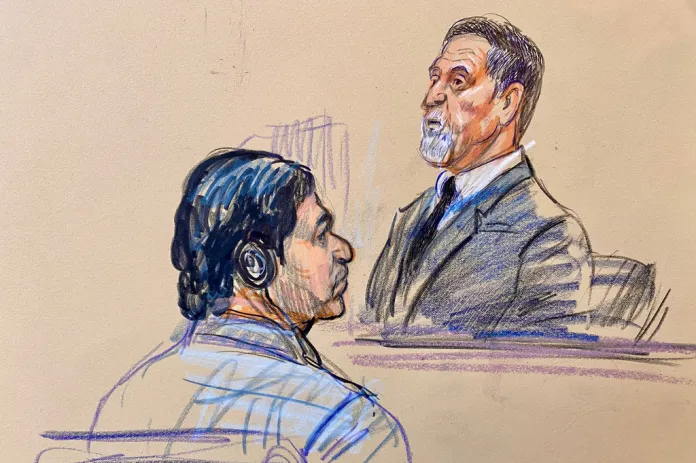
Virginia court sentences Mohammad Sharifullah to 20 years for role enabling Abbey Gate bombing that killed 13 U.S. servi
Coveragetap to expand ▾Spectrum: Mostly Center🌍US: 1 · Other: 1
- Prosecutors say Sharifullah surveilled a road leading to Hamid Karzai International Airport and reported the route was clear, work assigned by ISIS‑K leadership (per Washington Examiner).
- The jury deadlocked on whether Sharifullah was criminally responsible for the Abbey Gate bombing; his defense sought a 17‑year sentence (per Washington Examiner).
A federal judge in Virginia imposed a 20‑year prison term on Mohammad Sharifullah for conspiring to provide material support to the Islamic State of Iraq and ash‑Sham–Khorasan Province, concluding his limited role in ISIS‑K’s operations warranted the maximum statutory sentence for the single count of conviction. Prosecutors linked Sharifullah to the Aug.
26, 2021 Abbey Gate attack by saying he surveilled a road to Hamid Karzai International Airport and reported it was clear — information they say facilitated the suicide bombing that killed 13 U.S. service members and about 160 civilians (per Washington Examiner).
The conviction itself followed a federal jury verdict in April finding Sharifullah part of a nine‑year conspiracy to support ISIS‑K; the jury, however, deadlocked on whether he bore criminal responsibility specifically for the Abbey Gate explosion (per Washington Examiner).
Sharifullah’s defense had urged a 17‑year term, while the court imposed the 20‑year statutory maximum for the one‑count conviction (per Washington Examiner).
Court filings and prosecutor statements presented Sharifullah as a facilitator who conducted surveillance at the direction of ISIS‑K leadership; the available source does not include broader defense argumentation disputing the surveillance allegation beyond the sentencing recommendation (per Washington Examiner).
The case ties directly to the chaotic U.S. and coalition noncombatant evacuation operation at Hamid Karzai International Airport in August 2021: on Aug.
26, 2021, ISIS‑K operative Abdul Rahman al‑Logari detonated a body‑worn device at Abbey Gate, killing 13 U.S. service members and roughly 160 Afghan civilians, an attack prosecutors link to the information Sharifullah provided (per Washington Examiner).
With this sentence, federal prosecutors have secured punishment for a man they say materially aided a group whose attack produced one of the deadliest days for U.S. forces during the withdrawal; the source does not report whether prosecutors will seek additional charges or whether Sharifullah will pursue appeal (per Washington Examiner).
- - U.S. service members killed: 13 U.S. service members were killed in the Abbey Gate bombing linked by prosecutors to information Sharifullah provided, making Veterans and military families direct victims of the facilitation (per Washington Examiner). - Afghan civilian toll: Prosecutors tie Sharifullah’s actions to an attack that killed roughly 160 Afghan civilians at Abbey Gate, meaning Afghan noncombatants bore the primary human cost of the attack (per Washington Examiner). - Legal precedent and sentencing: The court imposed the statutory maximum for a one‑count material‑support conviction, signaling prosecutors can obtain long sentences for facilitators even when juries deadlock on direct responsibility for a specific killing (per Washington Examiner). - ISIS‑K operational reach: The conviction underscores that U.S. prosecutions continue to target individuals alleged to have provided tactical support to ISIS‑K during the 2021 Kabul evacuation, benefiting prosecutors and victims seeking accountability (per Washington Examiner).
Whether Mohammad Sharifullah files an appeal against the 20‑year sentence within the statutory timeframe for federal criminal appeals. 2) Whether federal prosecutors bring additional charges against Sharifullah or other alleged ISIS‑K facilitators connected to the Aug. 26, 2021 Abbey Gate bombing. 3) Whether U.S. Justice Department offices handling terrorism prosecutions use this sentence as a precedent in sentencing recommendations for other defendants tied to ISIS‑K activities during the Kabul evacuation.
Left- and right-leaning outlets are covering this story differently — in which facts to emphasize, which context to include, and how to frame causes and consequences.
7 specific areas where coverage diverges — see below.
- Only Washington Examiner is available in the packet; it frames Sharifullah as a facilitator whose surveillance helped enable the Abbey Gate bombing and emphasizes the sentence was the maximum (per Washington Examiner).
- The source states the jury deadlocked on whether Sharifullah was criminally responsible for the Abbey Gate bombing but also reports a conviction for participating in a conspiracy; the precise factual link between Sharifullah’s surveillance and the bomber’s actions remains contested by the jury’s deadlock (per Washington Examiner).
- No source text in this pack provides court transcripts or detailed defense arguments explaining why the jury deadlocked on criminal responsibility for the Abbey Gate bombing.
- No source text in this pack reports whether prosecutors will seek additional charges, whether Sharifullah will appeal, or the expected timeline for any appellate review.
- No source text in this pack includes Afghan family identifications, compensation actions, or victim‑impact statements from those killed at Abbey Gate.
- Washington Examiner reports 13 U.S. service members killed and roughly 160 Afghan civilians killed in the Abbey Gate bombing (per Washington Examiner).
- Prosecutors link Sharifullah’s surveillance to the bomber having a clear route to Abbey Gate; the jury deadlocked on whether that link made Sharifullah criminally responsible for the bombing (per Washington Examiner).
- Washington Examiner attributes the surveillance allegation and sentencing facts to prosecutors and court records; it attributes the 13 U.S. service members and roughly 160 civilian deaths to the Abbey Gate bombing (per Washington Examiner).