
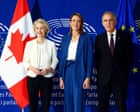
Von der Leyen offers Canada associate EU membership and broad security-trade pact
Coveragetap to expand ▾Spectrum: Center Only🌍Europe: 1 · Asia: 1 · Other: 1
- The invitation positions Canada as the first country the EU would name an associate member (per news.google.com).
- The story was highlighted by the Toronto Star in its reporting of von der Leyen's proposal (per news.google.com).
European Commission President Ursula von der Leyen publicly invited Canada to become the European Union's first associate member and coupled that offer with a proposal for a broad security and trade pact, according to reporting highlighted by news.google.com.
Von der Leyen framed the move as a deepening of ties that would bind Canada closer to EU defence and economic arrangements; Toronto Star coverage, which the aggregator highlights, stresses both security cooperation and expanded trade as central elements.
Canadian authorities' reactions are not detailed in the available coverage, so it remains unclear whether Ottawa will accept terms or seek modifications to sovereignty, procurement, or market-access provisions.
European officials have in the past used bespoke partnership formats to extend cooperation outside full membership; this invitation appears aimed at institutionalizing a privileged, formal relationship without conveying full EU membership rights.
Proponents in Brussels are likely seeking both to diversify strategic partnerships and to lock in regulatory alignment on trade and security standards; critics could argue such an arrangement risks creating asymmetries without clear dispute-settlement mechanisms.
The immediate next steps — whether Canada will enter negotiations, what mandate EU member states will give the Commission, and what timetable Brussels proposes — were not specified in the highlighted reporting, leaving the proposal at the invitation stage rather than as a negotiated agreement.
Absent further statements from Ottawa or specific text from the Commission, the proposal stands as a diplomatic opening that could reshape transatlantic ties if formalized.
- Canadian exporters face concrete regulatory and market-access effects: a trade pact tied to associate status would change tariff and standards alignment affecting Canadian sectors named in future negotiations (per updat3_article and key_facts).
- Canada's armed forces and defence procurement could incur specific commitments under the proposed security pact, shifting which Canadian defence programs coordinate with EU partners (per updat3_article and key_facts).
- The European Commission and member-state governments stand to gain geopolitical leverage in North America by institutionalizing closer ties with Canada, strengthening EU influence over transatlantic trade and security rules (per updat3_article and key_facts).
- Whether Canada accepts von der Leyen's invitation and formally enters negotiation talks with the European Commission by the end of the next quarter.
- A mandate vote by EU member states on authorizing Commission negotiations for an associate-membership framework and accompanying security-trade pact in the European Council.
- Whether Ottawa announces specific red lines on sovereignty, procurement, or regulatory alignment when it responds to the invitation.
Left- and right-leaning outlets are covering this story differently — in which facts to emphasize, which context to include, and how to frame causes and consequences.
7 specific areas where coverage diverges — see below.
- The Toronto Star (as highlighted by news.google.com) frames the invitation primarily as a move to deepen security and trade links; other outlets in the aggregator emphasize diplomatic symbolism rather than concrete negotiation details (per news.google.com).
- No source in the pack specifies whether Canada has accepted or will accept the invitation to negotiate.
- No source provides text of the proposed security or trade provisions, so the concrete commitments remain unverified.
- No source mentions specific prior agreements or triggers that led von der Leyen to make the invitation now (e.g., recent security incidents or trade disputes).
- No source provides estimated economic impacts by sector or numbers on defence commitments that would flow from an associate-membership pact.
- No source cites whether EU member states have approved launching formal negotiations or what voting thresholds would apply.
- No differing numerical figures are presented in the available source material.
- Sources do not attribute a specific triggering event that prompted von der Leyen's invitation; the action is reported without a named prior trigger (per news.google.com).
- The invitation and the proposal are attributed to Ursula von der Leyen in the aggregated coverage (per news.google.com).