
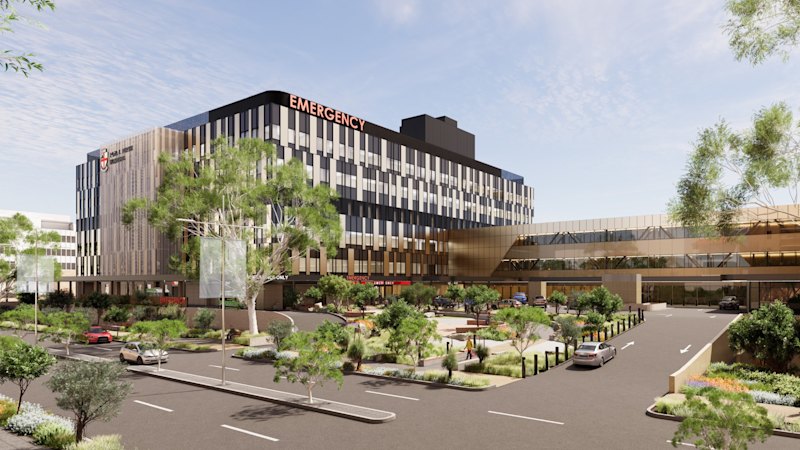
WA planning commission approves next stage of $807.3m Royal Perth Hospital emergency department expansion
Topic: healthRegion: asia pacificUpdated: i2 outletsSources: 2Spectrum: Center Only⏱ 4 min read⚠ 48h+ old
Story Summary
SITUATION
Western Australia’s Planning Commission approved the next stage of works for a new emergency department at Royal Perth Hospital, allowing construction of a nine-storey S Block, a three-storey enclosed link to R Block, access works and public realm upgrades (per smh.com.au). Stage 1 of the $807.3 million expansion — which began on June 19 and built the concrete slab, lift and stair cores and vehicle access ramps — is already complete and the Perth Pulse Alliance says the project is the largest recent redevelopment of the site (per smh.com.au).
Coveragetap to expand ▾Spectrum: Center Only🌍Asia: 1 · Africa: 1
Political Spectrum
Position is inferred from coverage mix.
i2 outlets · Center
Left
Center
Right
Left: 0
Center: 2
Right: 0
Geography Coverage
Distribution of where coverage is coming from.
i2 unique outlets · Dominant: Asia
KEY FACTS
- Western Australia’s Planning Commission approved an application for the next stage of works on a new emergency department at Royal Perth Hospital (per smh.com.au).
- The approved works include construction of a nine-storey hospital building called S Block (per smh.com.au).
- Stage 1 of the $807.3 million expansion began on June 19 and included the concrete slab, lift and stair cores, and vehicle access ramps from Wellington Street and Moore Street (per smh.com.au).
- The application was made by the Department of Housing and Works on behalf of the Perth Pulse Alliance and the Office of Major Infrastructure Delivery (per smh.com.au).
- Dion Di Crescenzo, deputy alliance manager for the Perth Pulse Alliance, told the WAPC the expansion is the largest redevelopment of the hospital site in recent history and uses an alliance delivery model to meet an accelerated timeframe (per smh.com.au).
- The new emergency department will be located on the north-western end of the hospital campus on Wellington Street in the Perth CBD (per smh.com.au).
HISTORICAL CONTEXT
The immediate backdrop is the wider geopolitical crisis that has shaped economic and supply-chain pressures: in March 2026 the United States and Israel launched coordinated strikes on Iran, initiating an ongoing campaign that has disrupted global energy markets and logistics networks.
Locally, Western Australia has been managing rising demand for emergency care driven by population growth and the legacy of pandemic-era capacity shortfalls, placing sustained pressure on state hospital planning and budgets.
Brief
Western Australia’s Planning Commission has given formal approval for the next stage of construction on a new emergency department at Royal Perth Hospital, clearing the way for a nine‑storey S Block, a three‑storey enclosed link to the existing R Block, upgraded emergency and vehicle access and public realm works (per smh.com.au).
The decision documents and developer application name the Department of Housing and Works as applicant and record the Perth Pulse Alliance and the Office of Major Infrastructure Delivery as delivery partners (per smh.com.au).
Stage 1 of the $807.3 million expansion began on June 19 and already delivered the concrete slab, lift and stair cores plus vehicle access ramps from Wellington Street and Moore Street, meaning crews will now move to vertical construction of the new tower and link (per smh.com.au).
Deputy alliance manager Dion Di Crescenzo told the Western Australia Planning Commission the project is the largest recent redevelopment of the Royal Perth Hospital site and is being delivered under an alliance model to meet an accelerated timeframe; that model pools public and private partners to share risks and schedule responsibilities (per smh.com.au).
The planning approval specifically covers public realm improvements, access works and connectivity to existing buildings, which the alliance says are essential to integrate the new emergency department into the north‑western corner of the campus on Wellington Street in the Perth CBD (per smh.com.au).
The Perth Pulse Alliance and the Office of Major Infrastructure Delivery remain the named delivery bodies on the application, with the Department of Housing and Works lodging the proposal on their behalf; the planning commission sign‑off is the regulatory gateway now permitting the alliance to proceed with the next construction stage (per smh.com.au).
Local traffic and access changes — including the vehicle ramps already built from Wellington and Moore Streets — were part of Stage 1 and are intended to support ambulance and patient flow for the new emergency department (per smh.com.au).
With the planning approval in hand, the alliance can escalate on‑site activity for the remaining works; the project team frames the build as delivering urgent extra emergency capacity for the hospital campus and as the largest redevelopment at Royal Perth in recent memory (per smh.com.au).
The single-source reporting in this release focuses on approvals, delivery partners, and stage sequencing; it does not include detailed contractor schedules, final construction completion dates, or itemised budget breakdowns beyond the $807.3 million project total (per smh.com.au).
Why it matters
- - Patients who use Royal Perth Hospital’s emergency department will bear the concrete costs and benefits: the new nine‑storey S Block and link aim to increase emergency capacity and improve ambulance access via the Wellington Street and Moore Street ramps already built (per smh.com.au). - Western Australia taxpayers and the Department of Housing and Works are financially exposed to the $807.3 million project total; the alliance delivery model shifts schedule and some risk management to the Perth Pulse Alliance (per smh.com.au). - The Perth Pulse Alliance and the Office of Major Infrastructure Delivery stand to benefit from contract work and management fees as construction advances now that planning approval is granted (per smh.com.au).
What to watch next
Whether the Perth Pulse Alliance commences vertical construction of S Block within the next quarter following the WAPC approval (per smh.com.au). 2) Whether the Office of Major Infrastructure Delivery publishes a revised construction schedule and definitive completion date for the emergency department (per smh.com.au). 3) Whether any further approvals or permits are required from the Western Australia Planning Commission or local authorities for public realm or traffic modifications (per smh.com.au).
Where sources differ
7 dimensionsFraming differences
?- Only smh.com.au is present; it frames the approval as a key procedural clearance enabling construction and emphasises the Perth Pulse Alliance's claim that this is the largest recent redevelopment of the site (per smh.com.au).
Disputed or unclear
?- No source disputes facts presented; the single source does not provide contractor schedules, final completion dates, or detailed budget line items (per smh.com.au).
Omitted context
?- No source mentions a final construction completion date or milestones beyond Stage 1 works (per smh.com.au).
- No source provides a detailed itemised budget breakdown or list of subcontractors and their contracts (per smh.com.au).
- No source supplies quantified patient‑capacity increases or projected wait‑time improvements tied to the new emergency department (per smh.com.au).
- No source outlines the specific traffic management plan or community consultation outcomes for Wellington and Moore Street access works (per smh.com.au).
Conflicting figures
?- All figures come from smh.com.au: project total $807.3 million; Stage 1 began on June 19 (per smh.com.au).
Disputed causality
?- The planning commission approval enabled the next construction stage; smh.com.au presents this as a procedural trigger for vertical works but provides no earlier trigger that led to the application beyond project planning (per smh.com.au).
Attribution disputes
?- smh.com.au attributes the application to the Department of Housing and Works acting on behalf of the Perth Pulse Alliance and the Office of Major Infrastructure Delivery (per smh.com.au).
Sources
2 of 2 linked articles