
↑Part of: Xi Jinping lands in New Delhi to present China’s BRICS proposals and meet Narendra Modi


Xi urges Modi: China and India should learn from each other as Global South powers
Topic: geopoliticsRegion: AsiaUpdated: i2 outletsSources: 4Spectrum: Center Only⏱ 3 min read📡 Wire pickup: 2⚠ 3d+ old
Story Summary
SITUATION
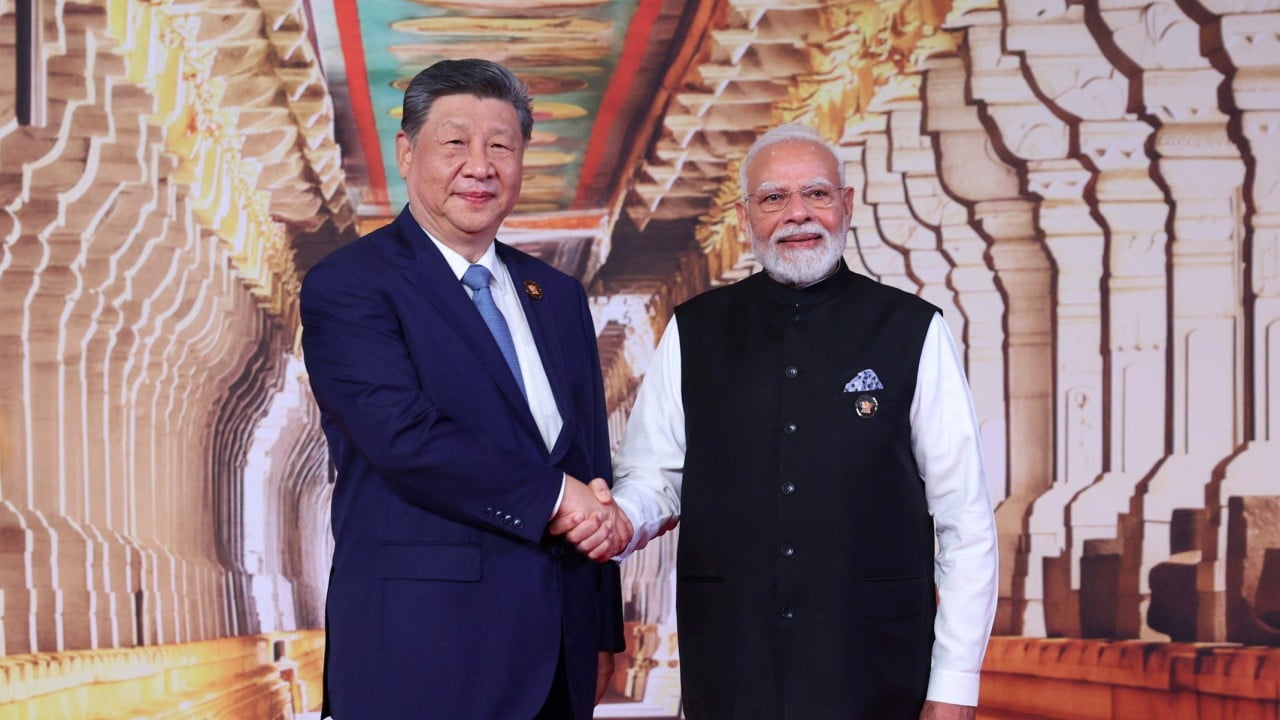
Chinese President Xi Jinping told Indian Prime Minister Narendra Modi that China and India bear "significant responsibilities" as Global South powers and should learn from each other’s strengths (per scmp.com). They met on the sidelines of the BRICS summit in New Delhi and India said they reaffirmed that "differences should not become disputes" (per scmp.com).
Coveragetap to expand ▾Spectrum: Center Only🌍US: 1 · Asia: 1
Political Spectrum
Position is inferred from coverage mix.
i2 outlets · Center
Left
Center
Right
Left: 0
Center: 2
Right: 0
Geography Coverage
Distribution of where coverage is coming from.
i2 unique outlets · Dominant: US/Canada
KEY FACTS
- Xi said China and India should learn from each other's strengths (per scmp.com).
- India said the leaders reaffirmed that "differences should not become disputes" (per scmp.com).
- The meeting was framed as an exchange between two major Global South powers rather than as a bilateral confrontation (per scmp.com).
HISTORICAL CONTEXT
The immediate backdrop is a period of heightened Global South diplomatic activity shaped by an active Middle East war that began in March 2026, when the United States and Israel launched coordinated strikes against Iranian power plants, air defenses and military infrastructure; those strikes and subsequent Iranian responses have pushed many developing-country leaders to seek unified platforms for crisis management and supply-chain resilience.
That dynamic intersected with a long-running India–China relationship marked by persistent border tensions and periodic high-level diplomacy aimed at managing rivalry rather than resolving it.
Brief
Chinese President Xi Jinping told Indian Prime Minister Narendra Modi that China and India carry "significant responsibilities" as Global South powers and should learn from each other’s strengths, a message Xi delivered when the two met on the sidelines of the BRICS summit in New Delhi (per scmp.com).
India characterized the exchange as an affirmation that "differences should not become disputes," signaling a shared interest in managing bilateral frictions without escalation (per scmp.com).
Xi’s appeal frames the relationship as one of mutual capacity-building among rising powers rather than a zero-sum contest; India’s wording emphasized restraint and dispute-management in parallel (per scmp.com).
The meeting – held amid the BRICS leaders’ gathering – positioned both capitals to present cooperative rhetoric to fellow Global South members while avoiding public confrontation over their outstanding disagreements (per scmp.com).
Neither source text attached a specific date to the leaders’ comments beyond situating them at the BRICS summit in New Delhi, and both accounts limit their reporting to leaders’ statements rather than listing concrete follow-up steps or agreements (per scmp.com).
The encounter underscores how Beijing and New Delhi are pitching their relationship to other developing countries: as partners who can learn from each other’s strengths and jointly shoulder responsibilities, even as both sides continue to manage bilateral differences away from public dispute (per scmp.com).
Why it matters
- Residents of India and China bear concrete costs from bilateral disputes: military deployments and border infrastructure investments divert budgetary resources away from domestic programs in both countries (per scmp.com).
- BRICS members benefit from a public China–India détente because it reduces the risk of an overt bilateral split that could complicate collective initiatives in New Delhi (per scmp.com).
- Political leaders in Beijing and New Delhi gain diplomatic leverage by portraying themselves as responsible Global South powers able to cooperate, strengthening their standing with other developing-country governments (per scmp.com).
What to watch next
Whether Xi Jinping and Narendra Modi issue any joint statement or communique at the close of the BRICS summit in New Delhi that lists specific cooperative initiatives (per scmp.com). 2) Whether either government announces follow-up bilateral talks or working groups to translate the leaders’ exchange into concrete projects by the next BRICS ministerial meeting (per scmp.com). 3) Whether other BRICS members publicly cite the China–India exchange when shaping their own positions at the summit in New Delhi (per scmp.com).
Where sources differ
7 dimensionsFraming differences
?- Only scmp.com frames the meeting as Xi urging mutual learning and records India’s line that "differences should not become disputes" (per scmp.com).
Disputed or unclear
?- No source disputes the leaders’ statements, but scmp.com provides only leaders’ quoted language without independent verification of follow-up actions (per scmp.com).
Omitted context
?- No source in this pack mentions specific outstanding triggers or incidents along the China–India border that preceded the leaders’ remarks.
- No source mentions civilian or military casualty figures, if any, related to bilateral tensions.
- No source cites any concrete economic projects, trade figures, or timelines tied to the leaders’ call to "learn from each other."
- No source mentions involvement by third-party governments in mediating China–India ties or any institutional mechanisms for dispute resolution between the two governments.
Conflicting figures
?- No differing numerical figures appear across sources in this pack.
Disputed causality
?- scmp.com reports leaders’ statements but does not establish a causal chain of a prior action that triggered the meeting’s conciliatory language (per scmp.com).
Attribution disputes
?- The language "significant responsibilities" and "learn from each other's strengths" is attributed to Xi Jinping; the phrase "differences should not become disputes" is attributed to India (per scmp.com).
Sources
4 of 4 linked articles
Indian Prime Minister Modi says border peace is key to India-China ties - cnbc.com
cnbc.comSep 12Left
↗
Xi tells Modi China and India bear ‘significant responsibilities’ as Global South powers
scmp.comSep 12Center
↗
China, Russia, Iran leaders gather in India as BRICS nations seek common ground - afp.com
afp.comSep 12Left
↗
China, India arranging meeting for Xi, Modi, China's foreign ministry says
reuters.comSep 11Left
↗