
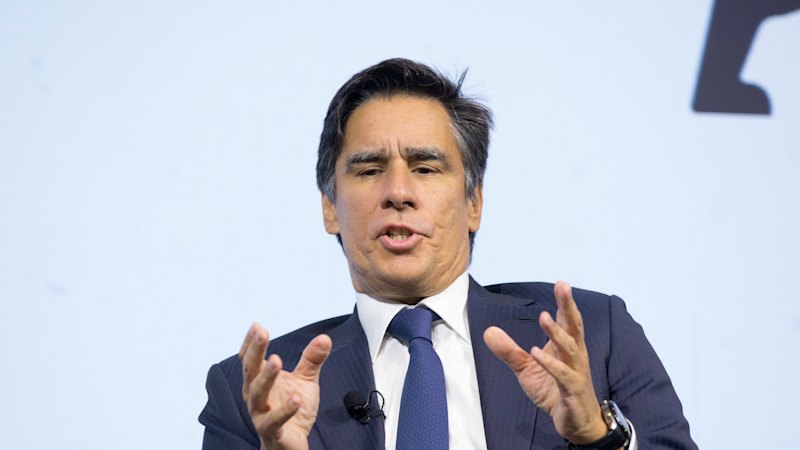
ANZ CEO Nuno Matos urges Australia to pick migrants 'like a business', echoing One Nation rhetoric
Coveragetap to expand ▾Spectrum: Left Only🌍Asia: 1
- Nuno Matos, ANZ chief executive, told an Australian Financial Review summit that Australia should handle its borders like a business, saying “In a company, in a business, you choose the people you hire” (per smh.com.au).
- Matos said: “You choose the people you hire, you choose the people you bring to your country, but you need them. You need them to grow the economy because they will bring talent” (per smh.com.au).
- The smh.com.au article connects Matos’s remarks to former prime minister John Howard’s 2001 line “we will decide,” saying that line has set the tone for Australia’s immigration debate since then (per smh.com.au).
- The piece notes Australia’s skilled migration program has existed in some form since the 1970s and has been copied by the United Kingdom, New Zealand and Canada (per smh.com.au).
ANZ chief executive Nuno Matos told an Australian Financial Review summit that Australia should “handle its borders like a business,” arguing “you choose the people you hire” and that a country should select migrants who bring the skills needed to grow the economy (per smh.com.au).
Matos framed migration as a talent and economic-growth decision: “You choose the people you hire, you choose the people you bring to your country, but you need them,” he said (per smh.com.au).
The Sydney Morning Herald frames Matos’s intervention as politically loaded, noting his language echoes former prime minister John Howard’s 2001 phrase “we will decide,” and saying that similarity links corporate voices with themes advanced by One Nation (per smh.com.au).
Supporters of a skills-based migration approach argue it ties entry to economic need and workforce shortages, while critics warn such language can mirror exclusionary politics; the smh.com.au piece explicitly places Matos’s remarks in that contested political terrain by comparing them to One Nation rhetoric (per smh.com.au).
Matos’s comments come amid long-standing Australian policy: the article notes Australia’s skilled migration program has existed in some form since the 1970s and influenced systems in the United Kingdom, New Zealand and Canada, which helps explain why corporate leaders discuss migrants in economic terms (per smh.com.au).
The newspaper frames a broader trend — that far-right parties have shifted political discourse — as the reason some business leaders now use language once confined to populist politicians, but the piece does not include Matos’s own policy prescriptions beyond his hiring metaphor, nor does it cite any ANZ policy document or data on how such a hiring-based selection would operate in practice (per smh.com.au).
Observers quoted or paraphrased in the article suggest the episode matters because it signals shifting norms in public debate when corporate executives adopt rhetoric associated with One Nation; the article stops short of documenting direct links between ANZ hiring practices and national migration policy proposals (per smh.com.au).
- - Australian workers facing specific skill shortages bear the concrete policy cost or benefit: selecting migrants by a business-style skills test would change which occupations receive new entrants and thus affect hiring pools in sectors with documented shortages (per smh.com.au). - Political actors like One Nation benefit from corporate echoes of their rhetoric because it normalises the party’s framing of migration, potentially expanding its influence over debate and policy priorities (per smh.com.au). - ANZ as a listed bank and its customers could gain reputational or market impacts if executive comments draw politicized backlash; the article links Matos’s public remarks to broader shifts in how CEOs engage on migration (per smh.com.au).
Whether ANZ issues an internal or public clarification of Nuno Matos’s remarks in the days after his AFR summit comments (per smh.com.au). 2) Whether Australian political parties, specifically One Nation or major parties invoking John Howard’s line, cite Matos’s comments in campaigning or policy debates ahead of any migration reform votes (per smh.com.au). 3) Whether ANZ or other banks propose concrete policy models translating a ‘hiring’-style selection into visa categories or employer-sponsored programs by the next policy consultation cycle (per smh.com.au).
- Only smh.com.au is in this pack; it frames Matos’s comments as echoing John Howard and One Nation and highlights political risk and rhetorical convergence (per smh.com.au).
- No source disputes Matos’s quotation, but the article does not present counter-evidence from Matos or ANZ beyond his quoted remarks, leaving his intent and any policy details unclear (per smh.com.au).
- No source in this pack provides ANZ’s internal policy documents, executive compensation data, or direct evidence of how a business-style migrant selection would be implemented; those gaps limit assessment of commercial incentives and practical impacts (per smh.com.au).
- No source mentions any specific migration statistics or which occupations Matos had in mind when saying migrants are needed, so the claim’s operational meaning is missing (per smh.com.au).
- No source cites reactions from migrant communities, union representatives, or specific political leaders beyond the historical John Howard comparison, omitting stakeholder responses (per smh.com.au).
- The single source does not provide differing numerical figures in this pack (per smh.com.au).
- The article links contemporary CEO rhetoric to a longer political shift toward One Nation-style framing but does not document a direct causal chain from specific political events to Matos’s remarks (per smh.com.au).
- The article attributes the quotation and view to Nuno Matos and attributes the comparison to John Howard’s 2001 line and to One Nation-era rhetoric (per smh.com.au).