
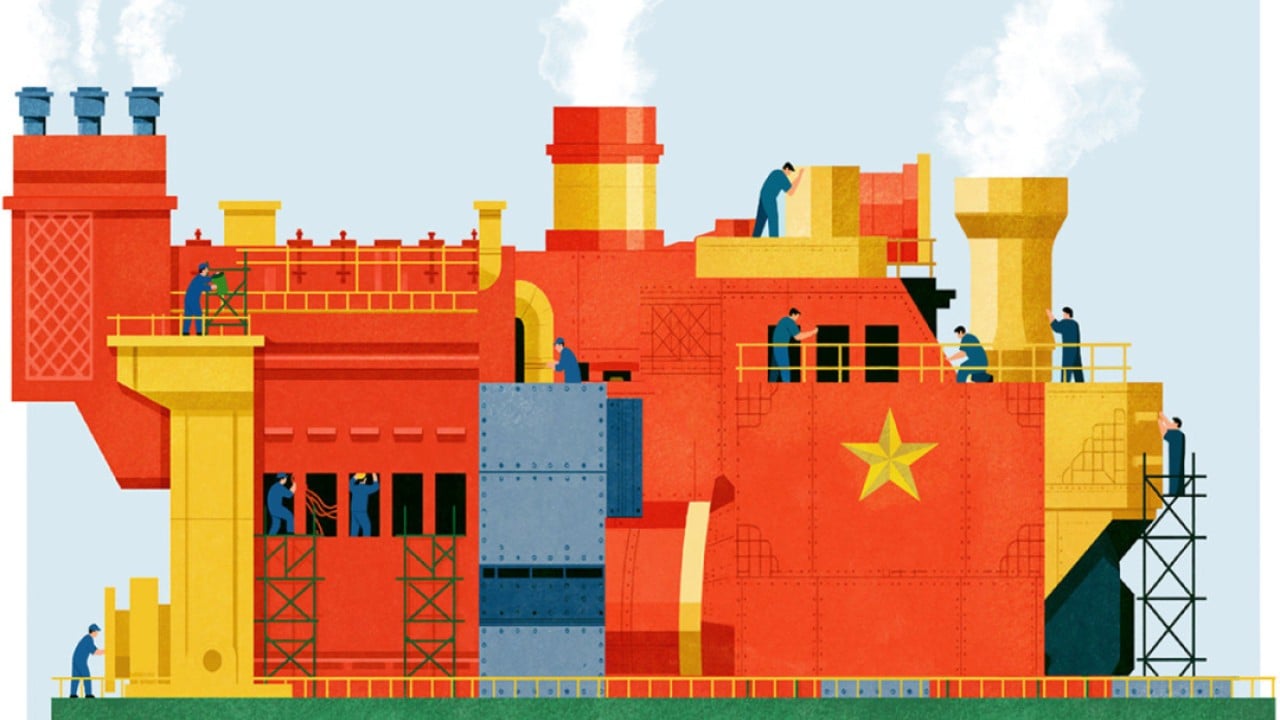
China scales EVs, batteries and chips despite tariffs and export controls
Coveragetap to expand ▾Spectrum: Center Only🌍Asia: 1
- China is expanding production in electric vehicles, batteries, solar panels and semiconductors despite tariffs and export controls (per scmp.com)
- Tariffs and export controls have not halted China’s industrial growth in these sectors, according to the analysis (per scmp.com)
China is rapidly expanding industrial-scale production in electric vehicles, batteries, solar panels and semiconductors even as trading partners deploy tariffs and export controls.
The analysis published by scmp.com documents that Beijing’s manufacturers have moved beyond early-stage experiments into mass production of mature clean-energy and chip technologies, and that those industrial gains have continued despite external trade restrictions.
Chinese firms and factories are increasing output in sectors that were once considered vulnerable to curbs, and the piece contends that policy measures aimed at restricting trade flows have not stopped the on-the-ground buildout of capacity.
The report frames this shift as a change in the core axis of competition: rather than primarily fighting over market access and tariff lines, governments and companies will now compete over who can physically supply the next waves of industrial growth across Asia, Africa and Latin America.
The scmp.com analysis does not present granular company-level data in this brief excerpt, but it emphasizes a strategic consequence — that production scale, logistics and financing will determine winners more than tariff schedules.
Policymakers in importing markets face a decision: escalate trade measures or pivot to investments and industrial policy that bolster alternative suppliers. The article asks which governments or firms will fill demand in developing markets and suggests the outcome will shape how effective export controls and tariffs remain as industrial-policy tools.
- Costs to consumers in Asia, Africa and Latin America: slower diversification of suppliers can raise prices for electric vehicles and clean-energy components because manufacturing concentration limits alternatives (per scmp.com).
- Costs to rival manufacturers outside China: firms that cannot match China’s scale risk losing market share in key developing markets as production — not tariffs — becomes the decisive factor (per scmp.com).
- Benefits to Chinese producers and their supply chains: firms that have scaled factories in EVs, batteries, solar and semiconductors stand to win contracts and market penetration in Asia, Africa and Latin America (per scmp.com).
- Whether governments in Asia, Africa or Latin America sign new procurement deals or industrial cooperation agreements with Chinese manufacturers in the next 12 months (per scmp.com).
- Whether importing governments adopt new industrial policies or financing packages to cultivate non-Chinese suppliers by the end of the coming year (per scmp.com).
- Whether exporting countries or trading blocs tighten export controls or broaden tariffs targeted at specific components within the next 12 months as a response to China’s scaling (per scmp.com).
- Only scmp.com is in this pack; it frames the story as a shift from trade competition to production competition and asks who will supply growth in Asia, Africa and Latin America (per scmp.com).
- No other sources present alternative claims or data; the degree of China’s manufacturing lead and the response options for other governments are not quantified in this single-source piece (per scmp.com).
- No source here provides company-level data or named firms that have scaled capacity, which would clarify which manufacturers are driving the growth (not mentioned in scmp.com).
- No source in this pack quantifies volumes, market shares, or specific tariff and export-control measures that were bypassed, leaving the magnitude of the effect unclear (not mentioned in scmp.com).
- No source mentions financing sources — state banks, export credit agencies or private finance — that enabled the industrial scaling (not mentioned in scmp.com).
- No source discusses supply-chain vulnerabilities (rare earths, packaging, assembly tiers) that would affect the sustainability of China’s scaling (not mentioned in scmp.com).
- No divergent figures are provided across sources; the single source does not include numerical production, market share or dollar values (per scmp.com).
- scmp.com attributes continued industrial growth to Chinese scaling despite tariffs and export controls, but does not detail the mechanisms by which firms overcame those barriers (per scmp.com).
- The article attributes the phenomenon to China’s expanding production capacity and poses a question about future suppliers; no alternate attributions are present in this pack (per scmp.com).