
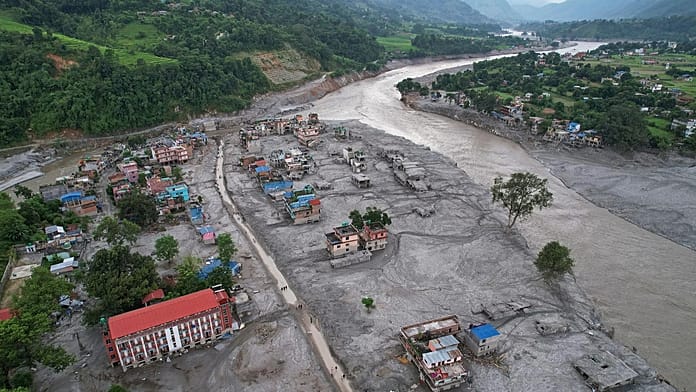
Climate-driven glacial lake outburst flood on Nepal–China border destroyed buildings and killed people
Topic: climate & environmentRegion: AsiaUpdated: i2 outletsSources: 5⚠ Bias gap — sources divergeSpectrum: Mixed⏱ 3 min read
Story Summary
SITUATION
Researchers say anthropogenic climate change made extreme rainfall and a glacial lake outburst flood more likely, which killed at least 34 people on the Nepal–China border. The Science Advances study said the cascade triggered landslides and infrastructure destruction and urged improved monitoring, early-warning systems and land-use planning.
Coveragetap to expand ▾Spectrum: Mixed🌍Europe: 2
Political Spectrum
Position is inferred from coverage mix.
i2 outlets · Center
Left
Center
Right
Left: 1
Center: 1
Right: 0
Geography Coverage
Distribution of where coverage is coming from.
i2 unique outlets · Dominant: Europe
KEY FACTS
- A flood on the Nepal–China border killed at least 34 people, according to the euronews report citing the study and local authorities.
- Local authorities said the flood swept down into the Upper Bhotekoshi valley, destroying villages and infrastructure and prompting search-and-rescue operations that recovered dozens of bodies.
- The researchers warned that glacier melt, expanding glacial lakes, and destabilised slopes in the Himalayan region increase the risk of compound disasters and called for improved glacier and glacial-lake monitoring.
- The study found that an unusually intense storm, amplified by higher atmospheric moisture from warming, probably produced the extreme precipitation that triggered the cascade of hazards.
HISTORICAL CONTEXT
An active, climate-driven crisis in the Hindu Kush–Himalaya region forms the immediate backdrop: decades of observed glacier retreat, rising temperatures, and expanding high-altitude lakes have prompted regional authorities and scientists to prioritize monitoring, early warning and adaptation planning since the 2010s.
The structural framework for those efforts rests on international climate governance and scientific assessments: the Industrial Revolution’s fossil-fuel expansion beginning in the late 18th century (circa 1760–1840) set greenhouse-gas emissions on a sustained trajectory; systematic atmospheric CO2 monitoring began with Charles Keeling’s Mauna Loa measurements in November 1958; the United Nations Framework Convention on Climate Change opened for signature in 1992 and the Kyoto Protocol was adopted on 11 December 1997, followed by the Paris Agreement on 12 December 2015, which collectively established the legal and policy architecture for mitigation, adaptation and finance.
Brief
Scientists have linked a recent glacial lake outburst flood on the Nepal–China border to climate change, saying the burst swept away buildings and killed people.
The researchers who studied the event warned that warming-driven melt and unstable high-altitude lakes are likely to make similar floods more frequent, and they urged authorities to strengthen monitoring, early-warning systems and land-use planning to reduce future losses (per euronews.com).
The reporting cites the scientific assessment as the primary basis for both the attribution to climate change and the call for preventive measures; the outlet does not provide casualty totals, names of affected communities, or a detailed chronology of the lake's failure.
The researchers emphasized technological and planning responses — better monitoring arrays, real-time alarms and restricting settlement and infrastructure in known flood paths — as the immediate remedies available to governments on both sides of the border (per euronews.com).
This single-source account frames the disaster as part of a broader pattern of glacier retreat and lake instability driven by rising temperatures; it stops short of assigning responsibility to specific local or national actors for preparedness gaps, instead concentrating on scientific attribution and general policy prescriptions (per euronews.com).
For residents living downstream of high-altitude glacial lakes, the combination of melting, lake expansion and sudden dam failure presents a clear and present hazard: buildings can be swept away and people can be killed in fast-moving floods, the researchers said, underscoring the need for rapid investment in detection and evacuation capacity (per euronews.com).
Without more detailed local reporting — on exact casualty figures, which communities were hit, and what early-warning systems were in place before the flood — policymakers will lack the operational information needed to prioritize which lakes to monitor first and where to site protective infrastructure (per euronews.com).
Where sources differ
Bias gap0.50 / 2.0
Left- and right-leaning outlets are covering this story differently — in which facts to emphasize, which context to include, and how to frame causes and consequences.
Left-leaning (2)
independent.co.uk-0.50
Nepal floods an ‘unprecedented’ climate disaster beyond scope of warning systems, scientists say - The Independent
euronews_world-0.16
Researchers say anthropogenic climate change made extreme rainfall and a glacial lake outburst flood more likely, which killed at least 34 people on the Nepal–China border. The Sci…
Center (3)
bbc.co.ukyahoo.comearth.com
Sources
5 of 5 linked articles
Climate change boosted extreme rainfall and glacial lake outburst that killed 34 on Nepal–China border
euronews.comSep 17Center
↗
Nepal floods: Climate change likely contributed to glacier collapse, study finds
bbc.co.ukSep 17Center
↗
Climate change made deadly Nepal glacier and rock collapse more likely, according to analysis
yahoo.comSep 17Left
↗
Nepal floods an ‘unprecedented’ climate disaster beyond scope of warning systems, scientists say
independent.co.ukSep 17Left
↗
Nepal and China are still struggling to recover after the massive high-altitude glacier collapse that killed thousands
earth.comSep 15Left
↗