
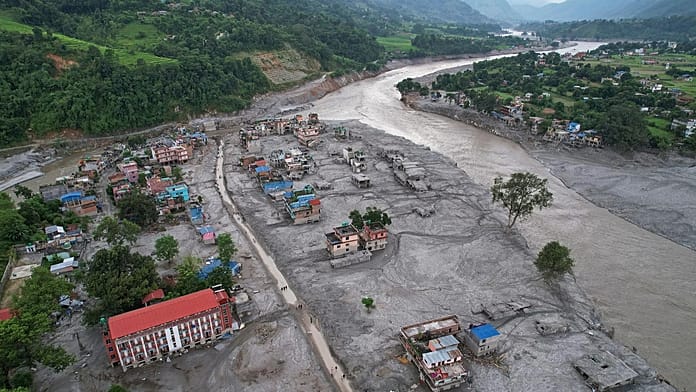
Climate-driven glacial lake outburst flood on Nepal–China border destroyed buildings and killed people
Coveragetap to expand ▾Spectrum: Mixed🌍Europe: 2
- A flood on the Nepal–China border killed at least 34 people, according to the euronews report citing the study and local authorities.
- Local authorities said the flood swept down into the Upper Bhotekoshi valley, destroying villages and infrastructure and prompting search-and-rescue operations that recovered dozens of bodies.
- The researchers warned that glacier melt, expanding glacial lakes, and destabilised slopes in the Himalayan region increase the risk of compound disasters and called for improved glacier and glacial-lake monitoring.
- The study found that an unusually intense storm, amplified by higher atmospheric moisture from warming, probably produced the extreme precipitation that triggered the cascade of hazards.
Scientists have linked a recent glacial lake outburst flood on the Nepal–China border to climate change, saying the burst swept away buildings and killed people.
The researchers who studied the event warned that warming-driven melt and unstable high-altitude lakes are likely to make similar floods more frequent, and they urged authorities to strengthen monitoring, early-warning systems and land-use planning to reduce future losses (per euronews.com).
The reporting cites the scientific assessment as the primary basis for both the attribution to climate change and the call for preventive measures; the outlet does not provide casualty totals, names of affected communities, or a detailed chronology of the lake's failure.
The researchers emphasized technological and planning responses — better monitoring arrays, real-time alarms and restricting settlement and infrastructure in known flood paths — as the immediate remedies available to governments on both sides of the border (per euronews.com).
This single-source account frames the disaster as part of a broader pattern of glacier retreat and lake instability driven by rising temperatures; it stops short of assigning responsibility to specific local or national actors for preparedness gaps, instead concentrating on scientific attribution and general policy prescriptions (per euronews.com).
For residents living downstream of high-altitude glacial lakes, the combination of melting, lake expansion and sudden dam failure presents a clear and present hazard: buildings can be swept away and people can be killed in fast-moving floods, the researchers said, underscoring the need for rapid investment in detection and evacuation capacity (per euronews.com).
Without more detailed local reporting — on exact casualty figures, which communities were hit, and what early-warning systems were in place before the flood — policymakers will lack the operational information needed to prioritize which lakes to monitor first and where to site protective infrastructure (per euronews.com).
Left- and right-leaning outlets are covering this story differently — in which facts to emphasize, which context to include, and how to frame causes and consequences.